| Table of Contents |
|---|
Example of iOS application managing media devices
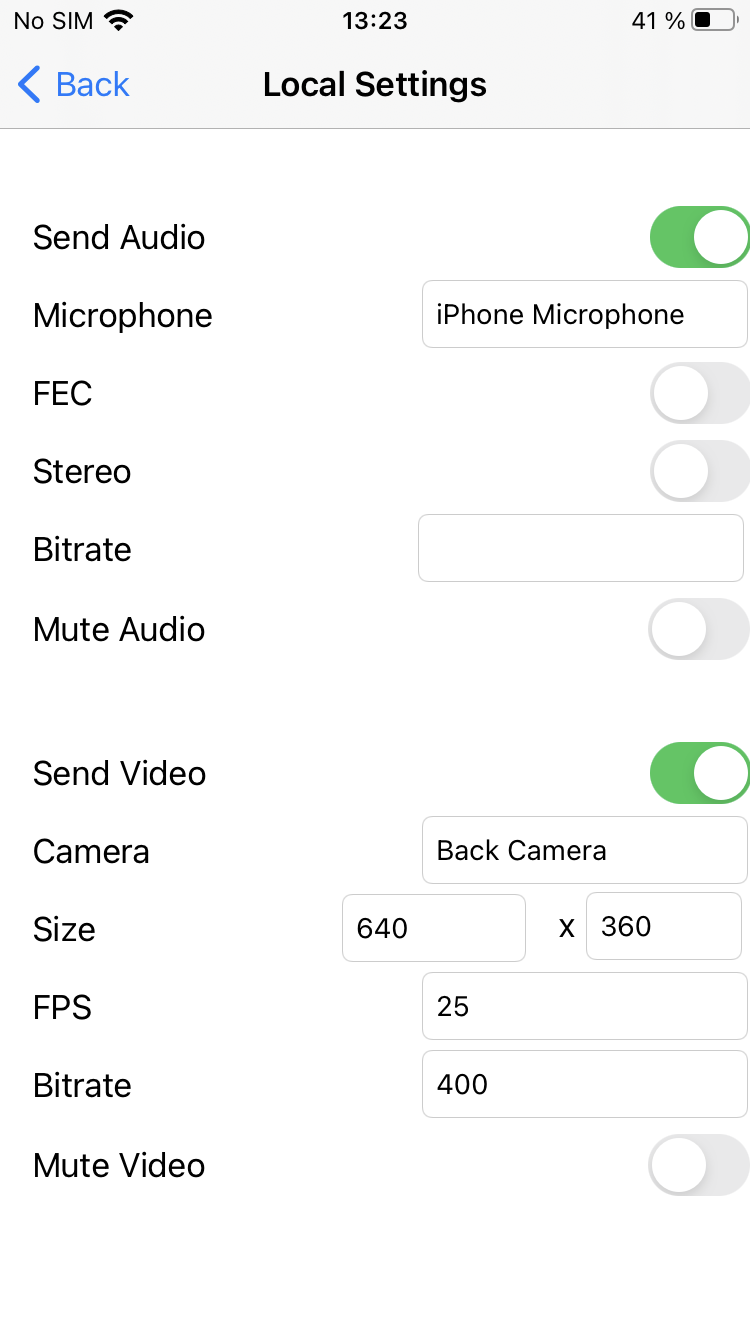
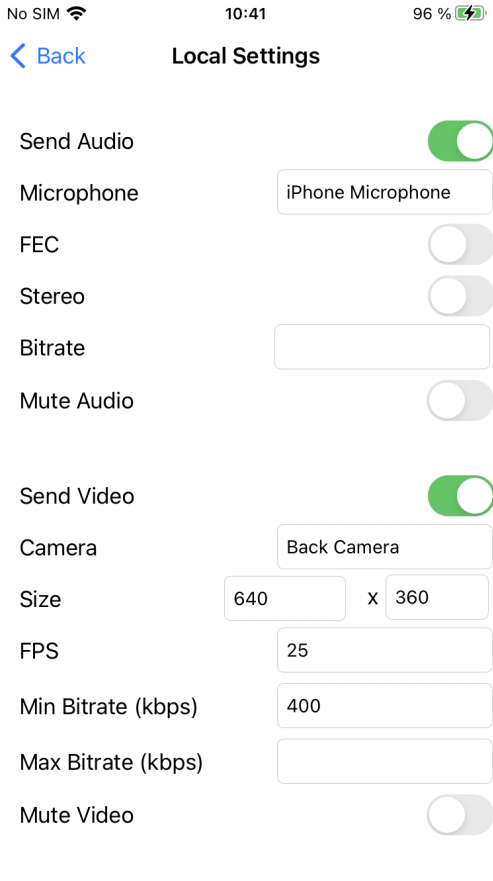
This example allows to publish WebRTC stream on Web Call Server and demonstrates selection of source camera and specification of the following parameters for published and played video
- resolution (width, height)
- bitrate
- FPS (Frames Per Second) - for published video
- quality - for played video
As well as publishing streams with audio and video, it allows to publish audio-only and video-only streams.
Audio and video can be muted when publishing is started (if corresponding controls has been set to ON before streaming was started), or while stream is being published.
Video streams can be played with or without video.
Some codecs may be excluded while publishing/plauing if needed.
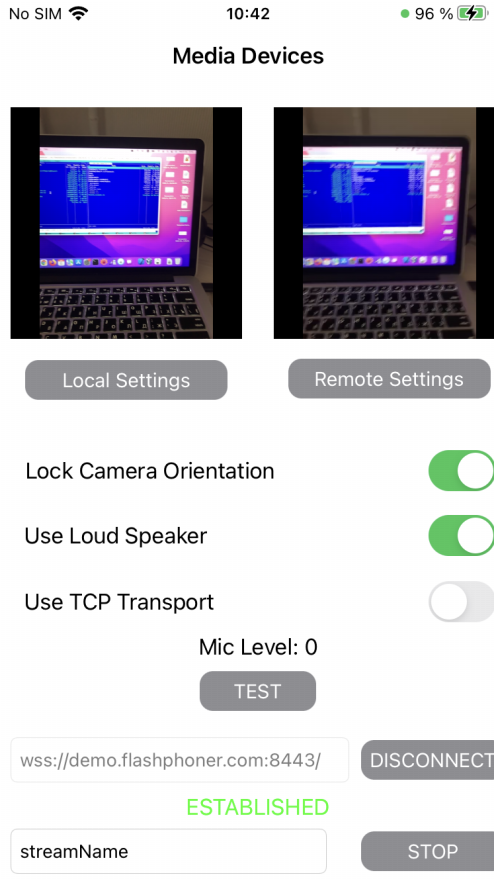
On the screenshot below the example is displayed when a stream is being published and played.
...
Stream published is displaing in the
...
Two videos are displayed
- left - video from the camera
- right - the published video stream is played from the server
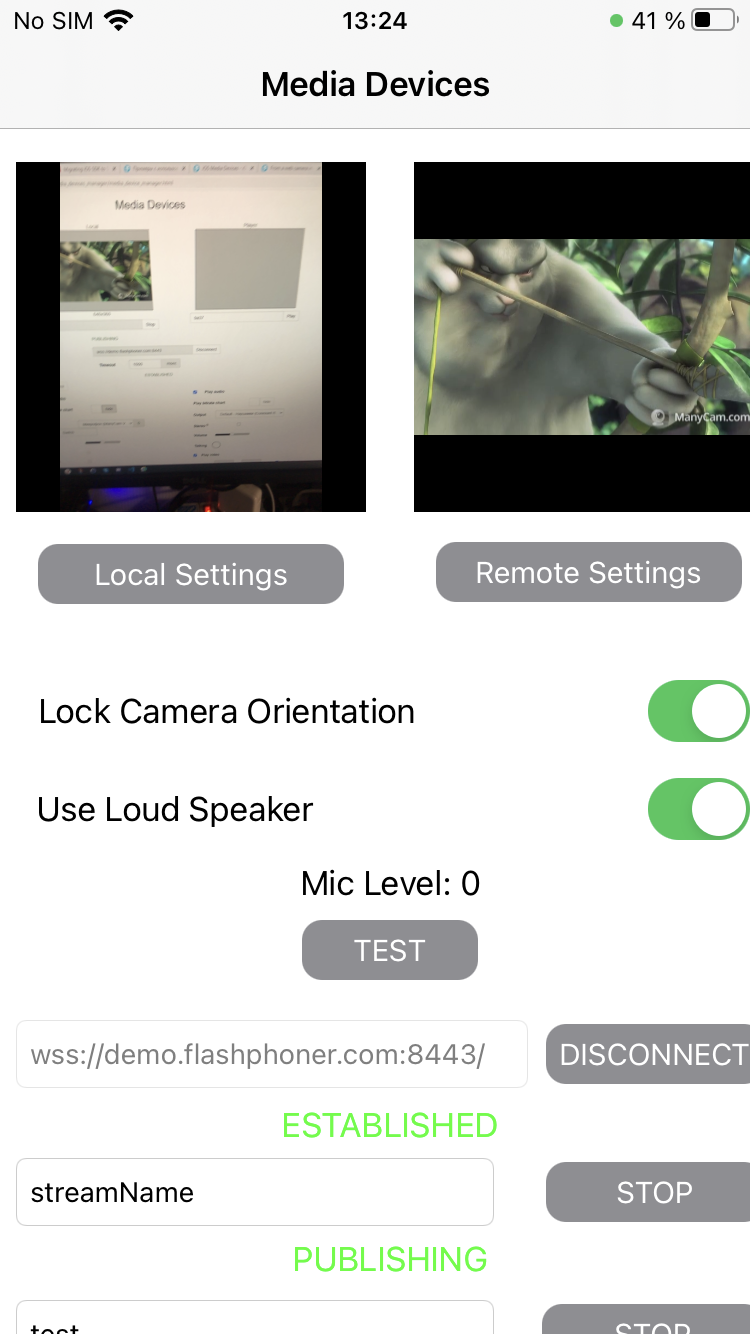
View with controls for publishing settings is left view, and stream played is displaing in the right view.
View with controls for publishing settings is displayed when 'Local settings' button is tapped
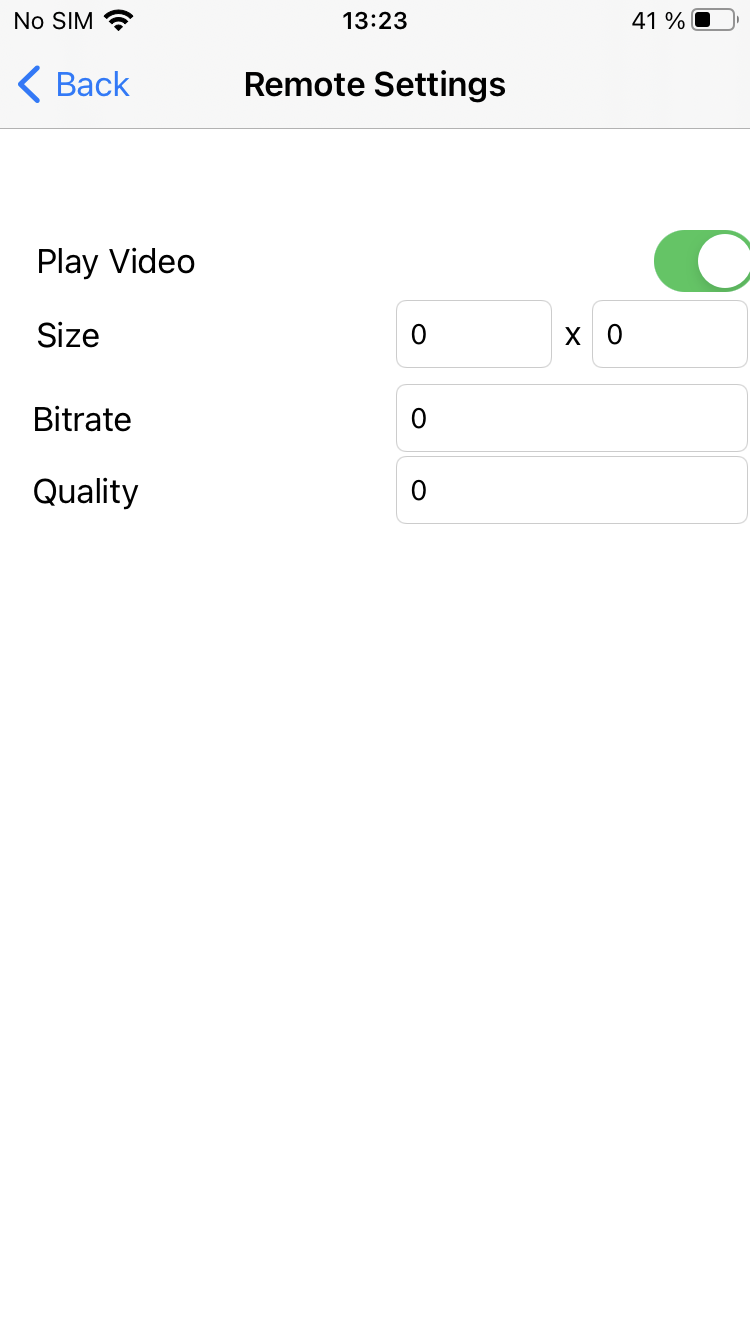
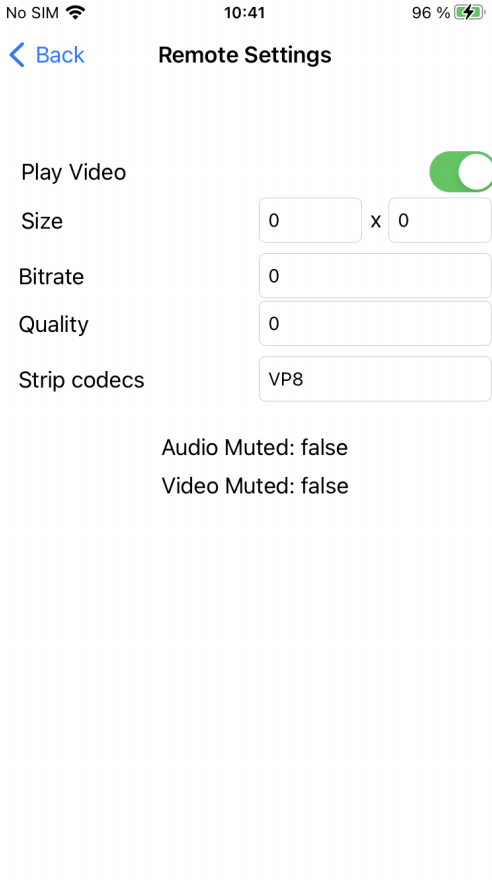
and view with controls for playback settings - when 'Remote settings' button is tapped.
Work with code of the example
To analyze the code, let's take MediaDevices example, which can be downloaded from GitHub.
View classes
- class for the main view of the application: ViewController ViewController (implementation file file ViewController.swift)
- class for view with publishing settings: LocalViewController LocalViewController (implementation file file LocalViewController.swift)
- class for view with playback settings: RemoteViewController RemoteViewController (implementation file file RemoteViewController.swift)
1. Import of API.
| Code Block | ||||
|---|---|---|---|---|
| ||||
import FPWCSApi2Swift |
2. List available media devices.
WCSApi2.getMediaDevices code
| Code Block | ||||
|---|---|---|---|---|
| ||||
localDevices = WCSApi2.getMediaDevices() |
...
FPWCSApi2MediaDeviceList.audio FPWCSApi2MediaDeviceList.video video code
| Code Block | ||||
|---|---|---|---|---|
| ||||
        if (localDevices?.audio?.count ?? 0 > 0) {
            microphone.text = (localDevices?.audio[0] as AnyObject).label
        }
        if (localDevices?.video?.count ?? 0 > 0) {
            camera.text = (localDevices?.video[0] as AnyObject).label
} |
4. Constraints for published stream publishing.
FPWCSApi2AudioConstraints, FPWCSApi2AudioConstraints FPWCSApi2AudioConstraints code
| Code Block | ||||
|---|---|---|---|---|
| ||||
    func toMediaConstraints() -> FPWCSApi2MediaConstraints {
        let ret = FPWCSApi2MediaConstraints()
        if (self.audioSend.isOn) {
            let audio = FPWCSApi2AudioConstraints()
            audio.useFEC = audioFEC.isOn
            audio.useStereo = audioStereo.isOn
            audio.bitrate = Int(audioBitrate.text ?? "0") ?? 0
            ret.audio = audio
        }
        if (self.videoSend.isOn) {
            let video = FPWCSApi2VideoConstraints()
            for device in localDevices!.video {
                if ((device as AnyObject).label == camera.text) {
                    video.deviceID = (device as AnyObject).deviceID;
                }
            }
            video.minWidth = Int(videoWidth.text ?? "0") ?? 0
            video.maxWidth = video.minWidth
            video.minHeight = Int(videoHeight.text ?? "0") ?? 0
            video.maxHeight = video.minHeight
            video.minFrameRate = Int(videoFPS.text ?? "0") ?? 0
            video.maxFrameRate = video.minFrameRate
            video.bitrateminBitrate = Int(videoBitratevideoMinBitrate.text ?? "0") ?? 0
            retvideo.videomaxBitrate = video;
        Int(videoMaxBitrate.text ?? "0") ?? 0
            ret.video = video;
        }
        return ret;
} |
5. Constraints for played stream playback.
FPWCSApi2AudioConstraints, FPWCSApi2AudioConstraints FPWCSApi2AudioConstraints code
| Code Block | ||||
|---|---|---|---|---|
| ||||
    func toMediaConstraints() -> FPWCSApi2MediaConstraints {
        let ret = FPWCSApi2MediaConstraints();
        ret.audio = FPWCSApi2AudioConstraints();
        if (playVideo.isOn) {
            let video = FPWCSApi2VideoConstraints();
            video.minWidth = Int(videoWidth.text ?? "0") ?? 0
            video.maxWidth = video.minWidth
            video.minHeight = Int(videoHeight.text ?? "0") ?? 0
            video.maxHeight = video.minWidth
            video.bitrate = Int(videoBitrate.text ?? "0") ?? 0
            video.quality = Int(videoQuality.text ?? "0") ?? 0
            ret.video = video;
        }
        return ret;
} |
6. Local camera and microphone testing
WCSApi2.getMediaAccess code
| Code Block | ||||
|---|---|---|---|---|
| ||||
    @IBAction func testPressed(_ sender: Any) {
        if (testButton.title(for: .normal) == "TEST") {
            let constraints = FPWCSApi2MediaConstraints(audio: true, video: true)!
            do {
                try WCSApi2.getMediaAccess(constraints, localDisplay.videoView)
            } catch {
                print(error)
            }
            testButton.setTitle("RELEASE", for: .normal)
        } else {
            WCSApi2.releaseLocalMedia(display: localDisplay.videoView);
            testButton.setTitle("TEST", for: .normal)
        }
} |
...
WCSSession, WCSSession.connect code
The options include:
- URL of WCS server
- appKey of internal server-side application (defaultApp)
| Code Block | ||||
|---|---|---|---|---|
| ||||
    @IBAction func connectPressed(_ sender: Any) {
        changeViewState(connectButton, false)
        if (connectButton.title(for: .normal) == "CONNECT") {
            if (session == nil) {
                let options = FPWCSApi2SessionOptions()
                options.urlServer = urlField.text
                options.appKey = "defaultApp"
                do {
                session = try WCSSession(options)
                } catch {
                    print(error);
                }
            }
            ...
            changeViewState(urlField, false)
            session?.connect()
        }
} |
...
WCSSession.createStream, WCSStream.publish code
Object with the following stream options is passed to createStream method:
- options.name - stream name
- options.display - view to display video
- options.constraints - audio and video constraints
- options.stripCodecs - codecs array to exclude from local SDP while publishing
- options.transport - WebRTC transport to use
| Code Block | ||||
|---|---|---|---|---|
| ||||
    @IBAction func publishPressed(_ sender: Any) {
        changeViewState(publishButton,false)
        if (publishButton.title(for: .normal) == "PUBLISH") {
            let options = FPWCSApi2StreamOptions()
            options.name = publishName.text
            options.display = localDisplay.videoView
            options.constraints = localMediaConstrains;
            do {
  options.stripCodecs = localStripCodecs?.split(separator: ",")
              try publishStreamoptions.transport = session!.createStream(options)
            tcpTransport.isOn ? kFPWCSTransport.fpwcsTransportTCP : kFPWCSTransport.fpwcsTransportUDP;
            do {
                try publishStream = session!.createStream(options)
            } catch {
                print(error);
            }
            ...
            do {
                try publishStream?.publish()
            } catch {
                print(error);
            }
        }
} |
9. Preview stream Stream playback
WCSSession.createStream, WCSStream.play code
Object with the following stream options is passed to createStream method:
- options.name - stream name
- options.display - view to display video
- options.constraints - audio and video constraints
- options.stripCodecs - codecs array to exclude from local SDP while playing
- options.transport - WebRTC transport to use
| Code Block | ||||
|---|---|---|---|---|
| ||||
    @IBAction func playPressed(_ sender: Any) {
        changeViewState(playButton,false)
        if (playButton.title(for: .normal) == "PLAY") {

            let options = FPWCSApi2StreamOptions()
            options.name = playName.text;
           let options.display = FPWCSApi2StreamOptions()remoteDisplay.videoView;
            options.nameconstraints = playName.textremoteMediaConstrains;
            options.displaystripCodecs = remoteDisplay.videoView;remoteStripCodecs?.split(separator: ",")
            options.constraintstransport = remoteMediaConstrains;
           tcpTransport.isOn ? kFPWCSTransport.fpwcsTransportTCP : kFPWCSTransport.fpwcsTransportUDP;
            do {
            playStream = try session!.createStream(options)
            } catch {
                print(error);
            }
            ...
            do {
                try playStream?.play()
            } catch {
                print(error);
            }
        }
} |
10. Stream playback stop.
WCSStream.stop code
| Code Block | ||||
|---|---|---|---|---|
| ||||
    @IBAction func playPressed(_ sender: Any) {
        changeViewState(playButton,false)
        if (playButton.title(for: .normal) == "PLAY") {
            ...
        } else{
            do {
                try playStream?.stop();
            } catch {
                print(error);
            }
        }
} |
11. Stream publishing stop.
WCSStream.stop code
| Code Block | ||||
|---|---|---|---|---|
| ||||
    @IBAction func publishPressed(_ sender: Any) {
        changeViewState(publishButton,false)
        if (publishButton.title(for: .normal) == "PUBLISH") {
            ...
        } else {
            do {
                try publishStream?.stop();
            } catch {
                print(error);
            }
        }

} |